What this tool does
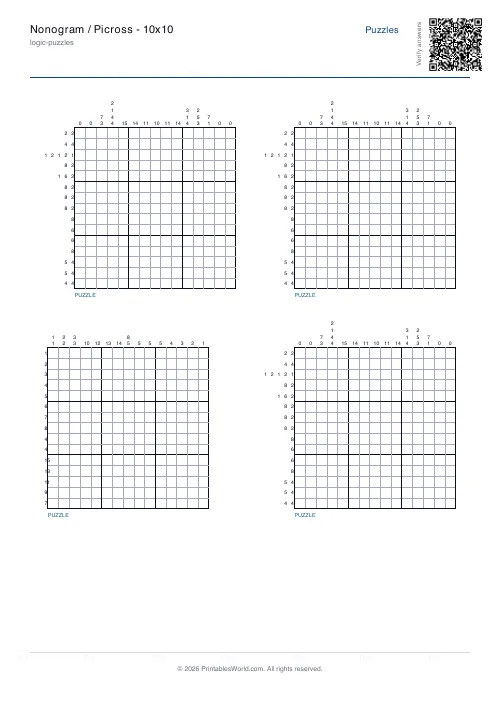
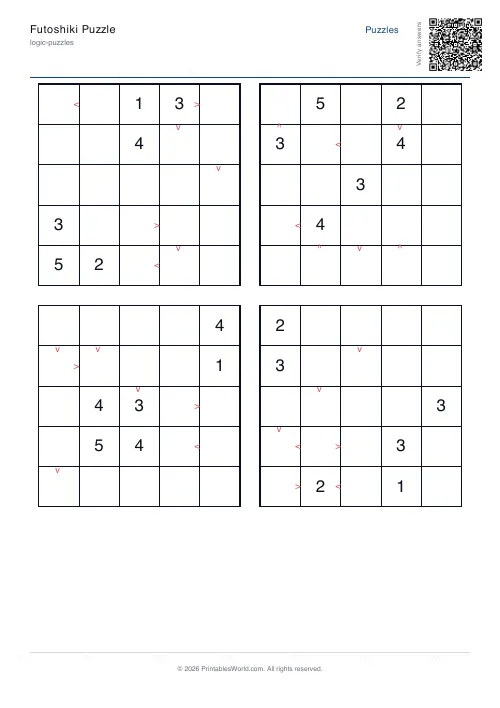
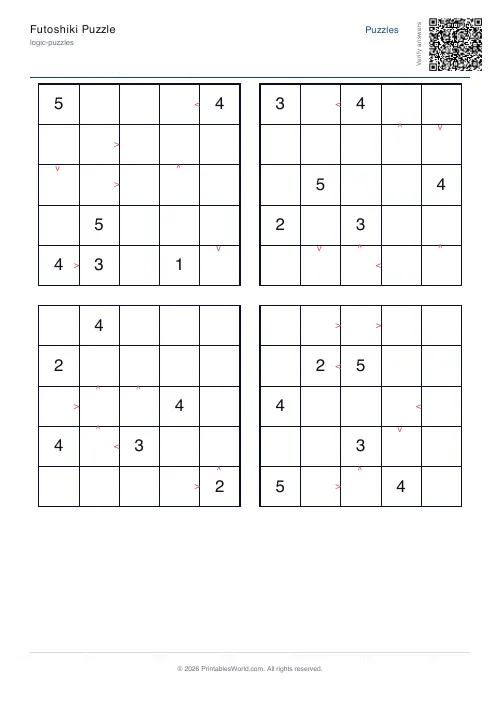
Futoshiki on a 5×5 grid: place 1 to 5 in every row and column, and respect every printed inequality sign between adjacent cells. One to eight puzzles a page, four by default, with an optional solutions sheet and a seed for reproducing a set exactly.
People also used
Feedback
Spotted something off with this tool?
Sudoku with the boxes replaced by signs
Fill a 5×5 grid so each row and each column carries the digits 1 to 5 exactly once. Between some adjacent pairs of cells sits a < or a >, and every one of them has to hold.
Futoshiki means inequality in Japanese, which is the whole puzzle in one word. The grid is small enough that a beginner can learn the rules and finish a puzzle in the same sitting, and the signs give a great deal of information away, so it is a much gentler entry point than a 9×9 anything.
One to eight puzzles a page, four by default.
Reading the signs
- A < between two cells means the left or upper one is smaller.
- A > means the opposite.
- Some cells start with a digit already printed, and some grids give you nothing at all and rely on the inequalities to carry the entire deduction.
- Every sign must hold in the finished grid, without exception.
That last point is what makes the puzzle work: an inequality is not a hint that might help, it is a constraint that eliminates. A single > rules out four of the twenty-five possible digit pairs before you have written anything.
Where to start on a fresh grid
Extremes first. A cell with signs pointing into it from both sides is the smallest in its line, and a cell with signs pointing away from it on both sides is the largest. Those are free.
Then chains. Three cells reading a < b < c must take three distinct increasing digits, which is a much stronger constraint than it looks: if a 2 is already placed elsewhere in that row, only 1, 3, 4 and 5 remain, and the increasing order leaves exactly four possible triples. Add one more given, say a 4 in the c cell, and it collapses to one.
Then Latin-square logic, which never stops applying: each digit exactly once per row and column, regardless of what the signs say.
Why it feels different from other grid puzzles
Most logic puzzles ask you to reason within a structure. Futoshiki asks you to combine a local clue, which is a relationship between exactly two cells, with a global rule about the whole line, and few other puzzles demand precisely that pairing.
The result is that information radiates. Place one digit and a chain of inequalities carries the consequence three cells away, which produces the one-move-unlocks-three feeling that good logic puzzles run on and this one delivers in a very small space.
Printing a set
Choose how many puzzles per sheet and whether to include the solutions page. Enter a seed if you want the same set again later, or leave it blank for something new each time.
Six to a page keeps the cells large enough to write digits in without crowding the signs between them, and eight is tight. Print at full scale on A4 or US Letter. There is no language content anywhere on the sheet, which makes it usable in any classroom and a fair puzzle for a child who finds word puzzles hard going.
FAQs
Quick answers
What does Futoshiki mean?
It is Japanese for "inequality". The puzzle uses < and > signs between cells to constrain values.
How big is the grid?
A 5x5 latin square is standard for printable Futoshiki.
How many puzzles per page?
Up to four to six puzzles per page in a 2-column layout.
Are answers included?
Yes. Toggle the solutions option for a second page.
Related tools
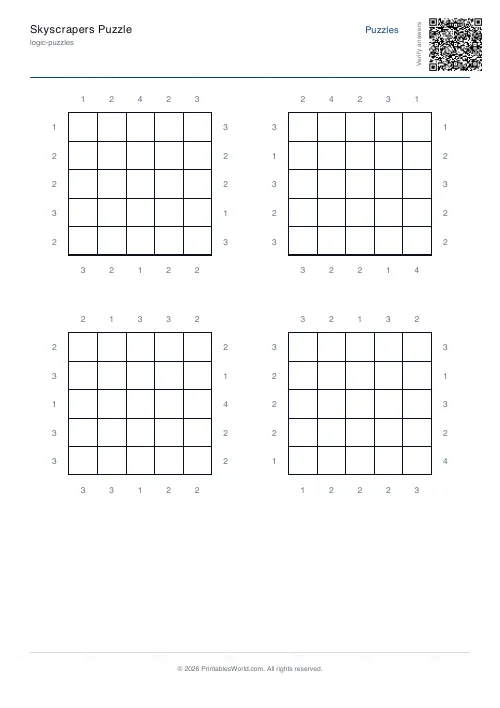
Skyscrapers Puzzle
Place buildings of different heights so clue numbers match visible buildings.
Calcudoku: 4x4
Four-by-four Calcudoku arithmetic puzzles. Operations include addition and subtraction.
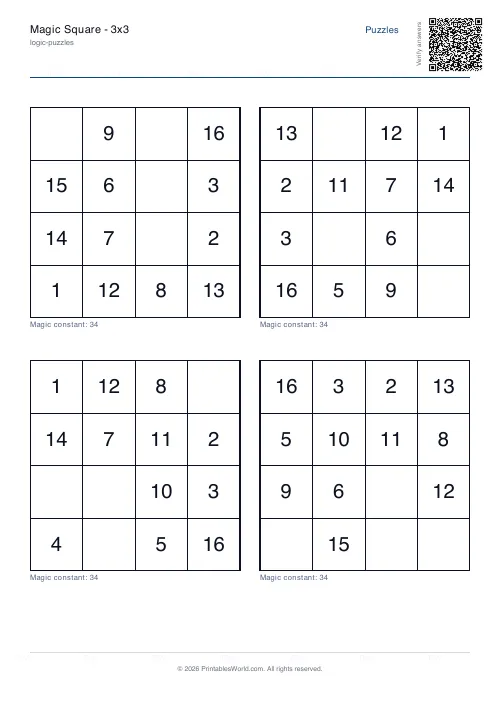
Magic Square: 3x3
Complete the 3x3 grid so all rows, columns, and diagonals sum equally.
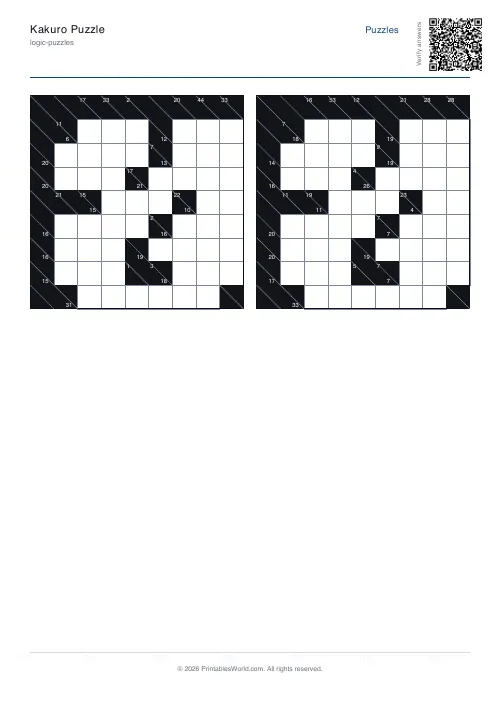
Kakuro Puzzle
Cross-sum number puzzle where digits in groups must add to clues.
Further reading
Logic Puzzles
The benefits of logic puzzles for developing brains
Logic puzzles teach deduction and persistence, which are worth having. The claim that they make children generally smarter is weaker than the marketing suggests.
5 min read
Puzzles & Brain Games
Printable brain games for seniors: a free puzzle pack
A free printable puzzle pack for older adults, with a sample seven-day plan, large-print and easier-difficulty tips, and how to use the Logic Puzzles collection.
7 min read
Logic Puzzles
Kakuro, killer sudoku and other number puzzles explained
If sudoku has stopped being a challenge, these are the natural next steps. And unlike sudoku, most of them genuinely involve arithmetic.
5 min read