What this tool does
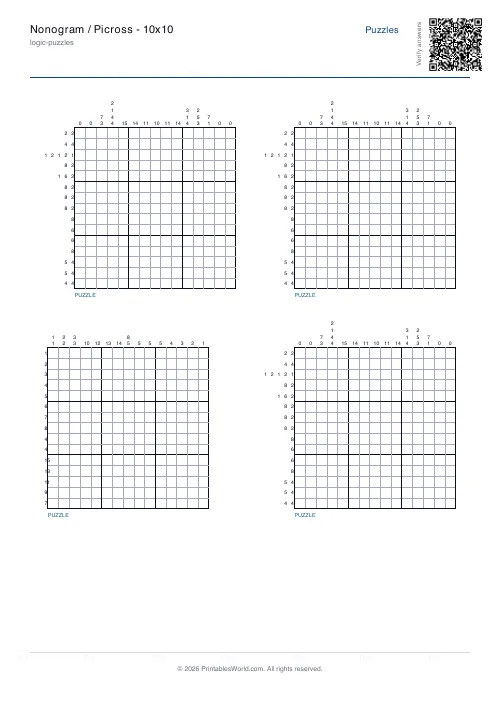
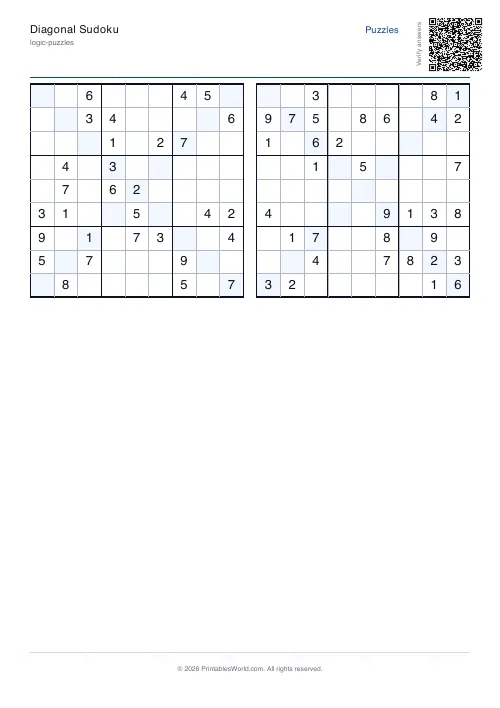
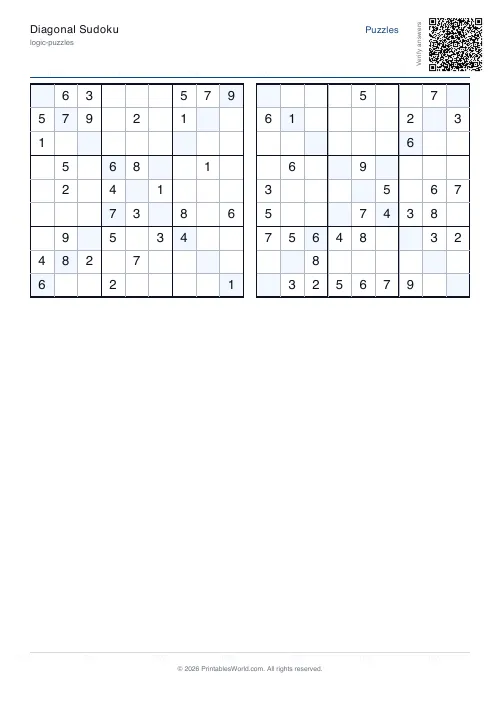
Diagonal Sudoku, also called X Sudoku. Standard 9×9 rules plus one more: each main diagonal must also hold every digit from 1 to 9. Both diagonals print tinted so the extra rule stays visible while you solve. One to four puzzles a page, two by default, with optional solutions and a seed to reproduce a set.
People also used
Feedback
Spotted something off with this tool?
One extra rule, drawn on the grid
Everything from standard Sudoku still applies: 1 to 9 in every row, every column and every 3×3 box, without repeating. Then both main diagonals must each hold all nine digits too.
Those two diagonals cross the grid as an X, which is where the variant's other name comes from, and they are printed with a tint so you can see them while you work. That matters more than it sounds: the commonest mistake in X Sudoku is solving a perfectly good standard Sudoku and forgetting the diagonal existed.
Two puzzles a page by default. Up to four.
What the diagonals give you
- The top-left to bottom-right diagonal holds every digit from 1 to 9.
- So does the top-right to bottom-left diagonal.
- They share exactly one cell, dead centre of the grid.
Treat each diagonal as an extra row and the whole variant becomes familiar. It is nine cells that must contain nine different digits, and every technique you already use on a row works on it unchanged.
The centre cell is the interesting one. It sits on both diagonals, a row, a column and a box, so a single digit placed there constrains five separate regions at once. Solve it early if you can.
A worked deduction
Say the top-left to bottom-right diagonal already carries 2, 5, 7, 9 and 3 somewhere along it. Nine cells, five filled, so four are left, and between them they must take 1, 4, 6 and 8 in some order.
Four candidates across four cells is not much on its own. But each of those cells also sits in a row, a column and a box that have their own restrictions, and when you intersect the diagonal's shortlist with the box's, it is common for only one digit to survive. That is the move the variant is built around, and it is why a diagonal deduction often opens three boxes at once rather than one.
How to solve it differently
- Scan both diagonals before anything else. Whatever is already on them tells you a great deal about the centre row and column.
- Keep pencil marks on diagonal cells light, because the diagonal frequently eliminates a candidate that looks entirely reasonable from the box alone.
- Once seven digits sit on a diagonal, the last two cells behave exactly like a two-cell row and usually resolve immediately.
A good first variant
There is no new arithmetic to learn and no unfamiliar region shape. If you can do a normal Sudoku, you can do this one on the first attempt, and the tint means you will not forget the rule halfway down.
But the extra constraint is not cosmetic. Every digit has to appear on each diagonal, which threads the two halves of the grid together in a way classic Sudoku never does, and a deduction made in one corner can resolve something in the opposite one. That is what makes it worth doing, and not merely different.
Every board starts as a fully solved grid that already satisfies the diagonal rule, and clues come out only for as long as a unique solution survives their removal. Type a seed to reproduce a set. Leave it blank for something new.
FAQs
Quick answers
What is "X Sudoku"?
Another name for Diagonal Sudoku. The two diagonals form an X across the grid.
Are diagonals shaded in the PDF?
Yes. Both main diagonals get a light tint to keep the extra constraint visible.
How many per page?
Two grids per page in a 1×2 layout.
Other variants?
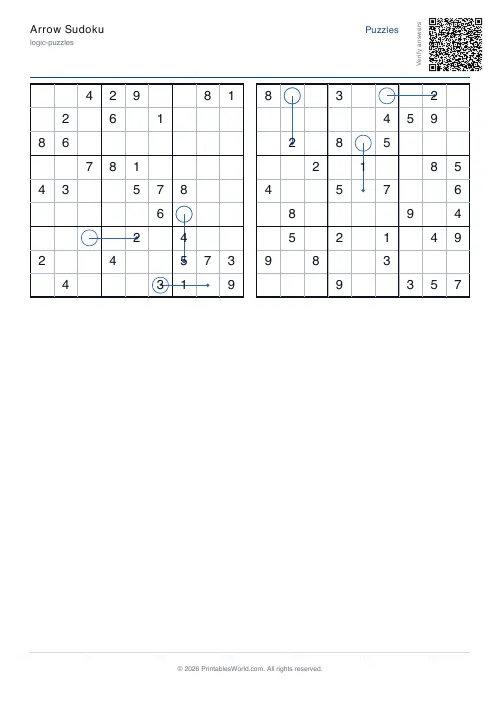
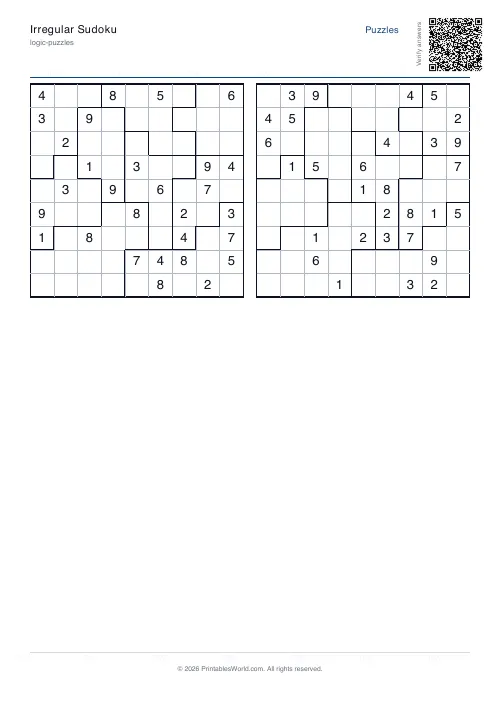
Try Arrow, Thermo, or Irregular Sudoku.
Related tools
Further reading
Logic Puzzles
How to solve Sudoku: a beginner's step-by-step guide
Four techniques, learned in order, solve almost every easy and medium Sudoku: scanning, the last free cell, pencil marks and naked pairs. Here is each one with a worked example.
6 min read
Logic Puzzles
Kakuro, killer sudoku and other number puzzles explained
If sudoku has stopped being a challenge, these are the natural next steps. And unlike sudoku, most of them genuinely involve arithmetic.
5 min read
Puzzles & Brain Games
Sudoku for kids: which difficulty to start at, by age
A practical guide to picking the right sudoku difficulty for a child by age, with a copyable first session and free printable grids in seconds.
7 min read