What this tool does
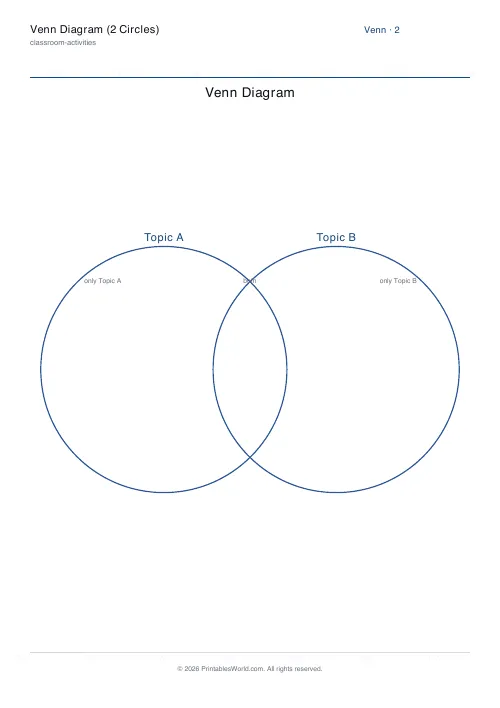
Two overlapping circles with your own labels, and hints marking the only-A, both, and only-B regions.
People also used
Feedback
Spotted something off with this tool?
Two circles, three regions
Type a label for each circle and a title, and the sheet prints two overlapping circles with the three regions marked: what belongs to the first only, what belongs to both, and what belongs to the second only.
The region hints are there because a surprising number of children put everything in the overlap on their first attempt, and a surprising number of adults put nothing in it.
The overlap is the exercise
Anyone can list features of two things. The Venn diagram asks a harder question: which of those features are shared?
Answering it means holding both lists in mind at once and checking each item against the other side, which is genuinely more demanding than writing two lists and considerably more useful. It is also the step that most compare-and-contrast writing skips, which is why so much of it reads as two descriptions with the word "however" between them.
Choosing two things worth comparing
They need enough in common to fill the middle and enough difference to fill the sides. That is a narrower target than it sounds.
Frogs and toads works: the overlap is real and the differences are specific. Frogs and bicycles does not — the overlap is empty and the sides are just two descriptions. Nor does comparing two things that are nearly identical, where the outer regions run dry.
A good test before you print: can you name three things for each of the three regions? If not, pick a different pair.
Filling it in the productive order
Start in the middle. It is the harder region and the one people run out of energy for if they leave it until last.
Then do the outer sections, and check each entry against the other circle as you write it — the commonest error is putting something in an outer region that is in fact true of both.
Read it back at the end by region: "these are only true of A, these are true of both". Errors are obvious said out loud and invisible on the page.
Beyond compare-and-contrast
It works for sorting, where the circles are categories and the items go where they belong — multiples of 3 and multiples of 4, with 12 in the middle.
It works for decisions, where the circles are two options. And it works as a starting diagram for an essay, since the three regions map onto three paragraphs almost exactly.
What you set
A title and a label for each circle. Paper size A4 or US Letter.
Leave the labels generic and print a stack. For a third circle and seven regions, use the three-circle version — but only when three things genuinely need comparing, because the extra regions are hard to fill.
FAQs
Quick answers
What is a Venn diagram good for?
Comparing and contrasting two things. Shared attributes go in the middle, unique attributes go in the outer crescents. Useful for vocabulary, science, history, and character studies.
Can I change the circle labels?
Yes. Enter any label in the two label fields; the PDF prints them above each circle.
Is there a 3-circle version?
Yes. See the "Venn Diagram (3 Circles)" tool for a three-set comparison.
Does it have writing lines inside?
No. The inside of each region is deliberately blank so students can write, draw, or paste notes freely.
Related tools
Further reading
Classroom Activities
Back-to-school printables every teacher needs
Sorted by when you will actually need them: the two things to print before the children arrive, the week-one set, and the routines worth establishing while everyone is still compliant.
5 min read
Classroom Activities
20 classroom games that need zero prep
Games organised by the gap they fill: two minutes at the end of a lesson, ten minutes before assembly, or a whole wet lunchtime. Almost all need nothing but a voice.
6 min read
Classroom Activities
How to make learning stations work in any classroom
Stations fail for two predictable reasons: the independent tasks are not truly independent, and the timing is wrong. Both are fixable before the lesson starts.
5 min read