Logic Puzzles
Number Pyramid — Small
Add two adjacent numbers to find the number above. 4-5 row pyramids.
Last updated:
What this tool does
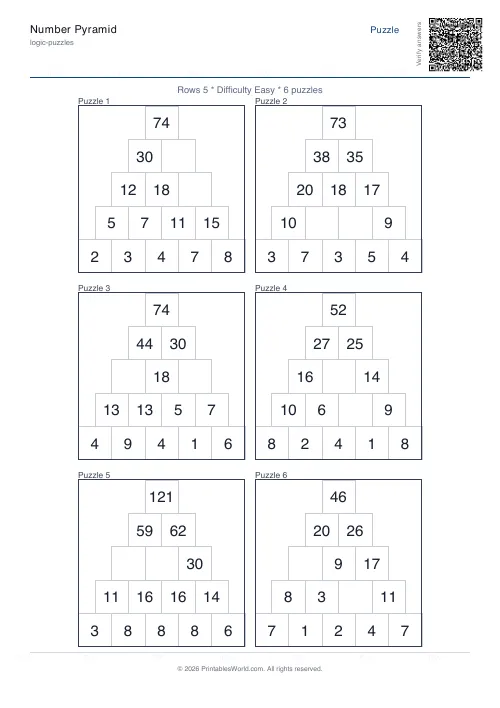
Small number pyramids built for early addition practice. Each block equals the sum of the two beneath it. 4 or 5 rows with easy ranges, six puzzles per page, and an optional solutions page.
Free downloads
Ready-made Number Pyramid Puzzle printables — free PDF downloads
No setup needed — download these print-ready number pyramid puzzles as free PDFs. Each one was made with the generator above, so you can recreate or fully customize any of them.
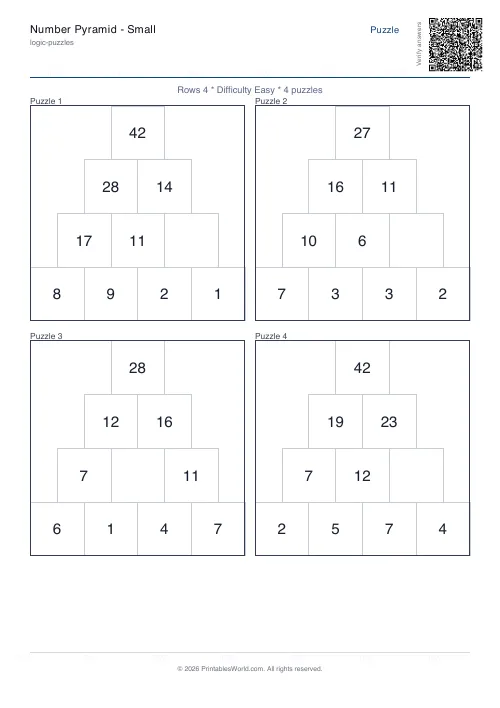
Number Pyramid Puzzle — Easy
Print-ready number pyramid puzzle (Easy) as a free PDF — made with the generator above so you can tweak and reprint.
↓ Download PDF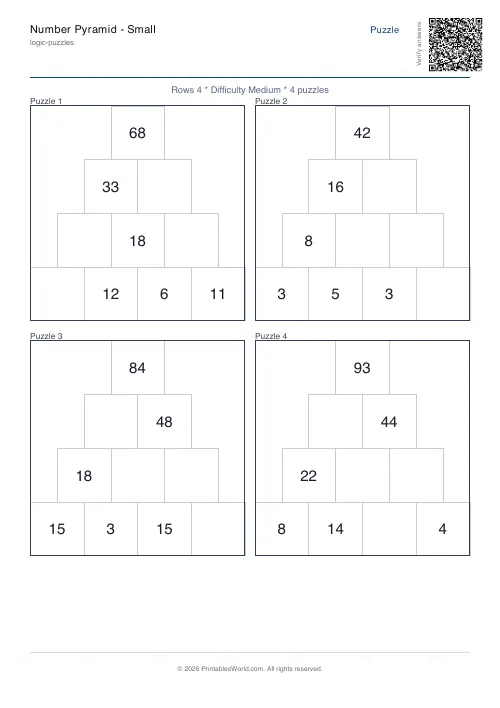
Number Pyramid Puzzle — Medium
Print-ready number pyramid puzzle (Medium) as a free PDF — made with the generator above so you can tweak and reprint.
↓ Download PDF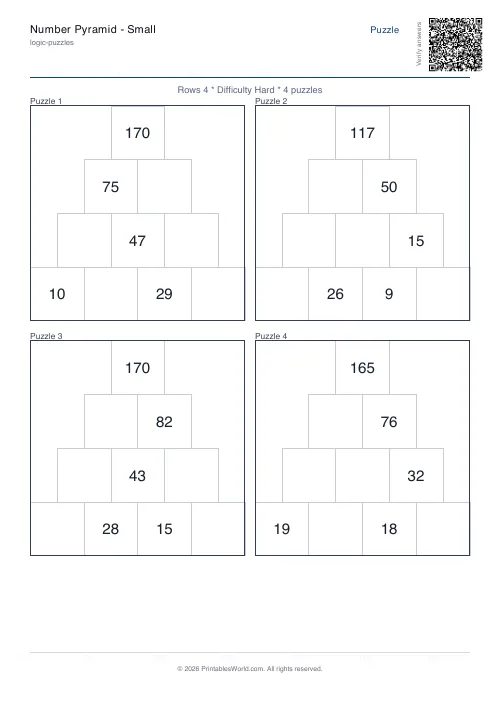
Number Pyramid Puzzle — Hard
Print-ready number pyramid puzzle (Hard) as a free PDF — made with the generator above so you can tweak and reprint.
↓ Download PDF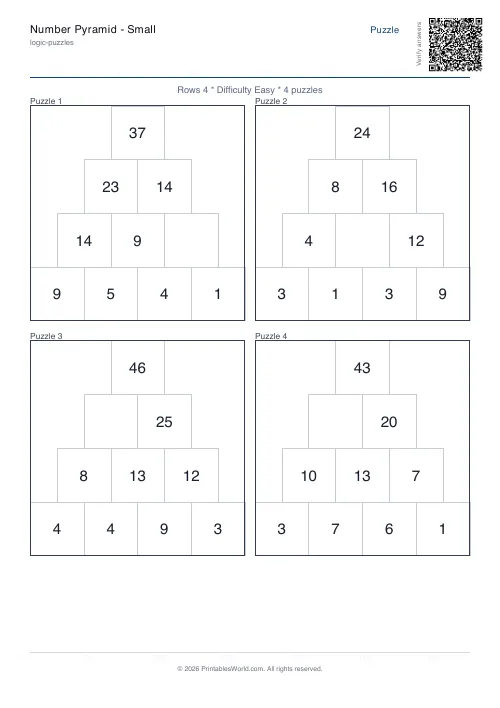
Number Pyramid Puzzle — 4 rows
Print-ready number pyramid puzzle (4 rows) as a free PDF — made with the generator above so you can tweak and reprint.
↓ Download PDF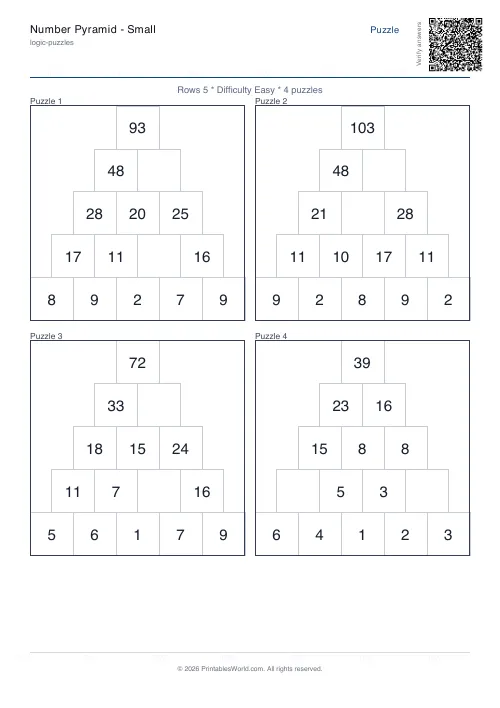
Number Pyramid Puzzle — 5 rows
Print-ready number pyramid puzzle (5 rows) as a free PDF — made with the generator above so you can tweak and reprint.
↓ Download PDF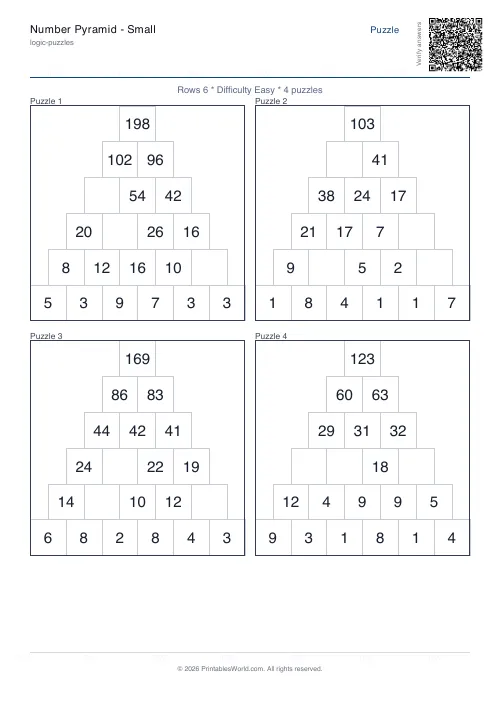
Number Pyramid Puzzle — 6 rows
Print-ready number pyramid puzzle (6 rows) as a free PDF — made with the generator above so you can tweak and reprint.
↓ Download PDF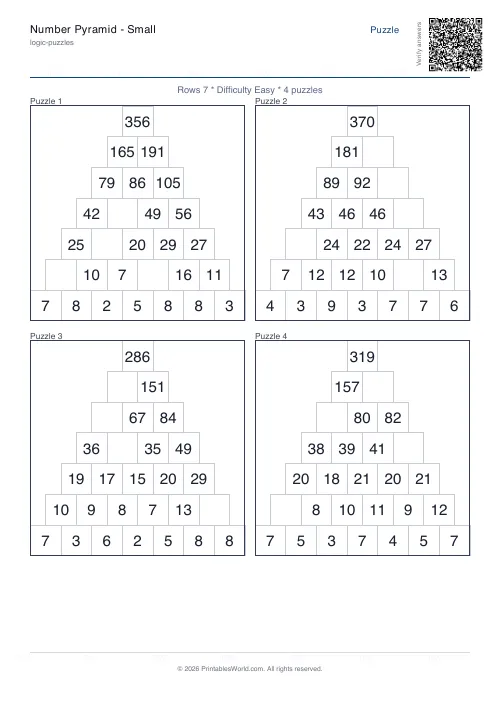
Number Pyramid Puzzle — 7 rows
Print-ready number pyramid puzzle (7 rows) as a free PDF — made with the generator above so you can tweak and reprint.
↓ Download PDF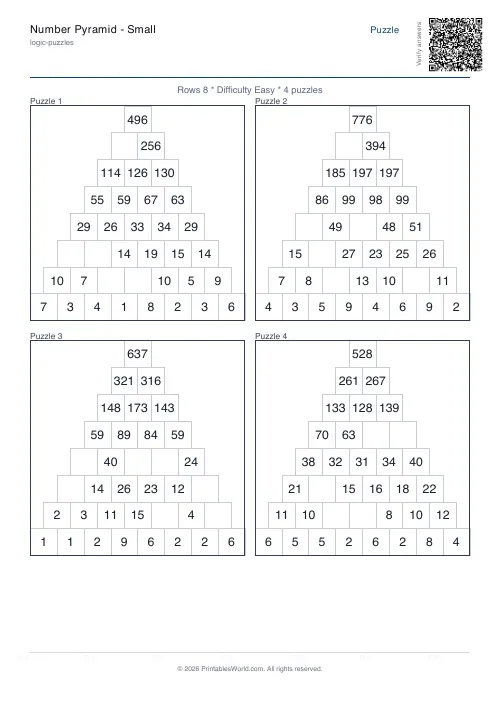
Number Pyramid Puzzle — 8 rows
Print-ready number pyramid puzzle (8 rows) as a free PDF — made with the generator above so you can tweak and reprint.
↓ Download PDF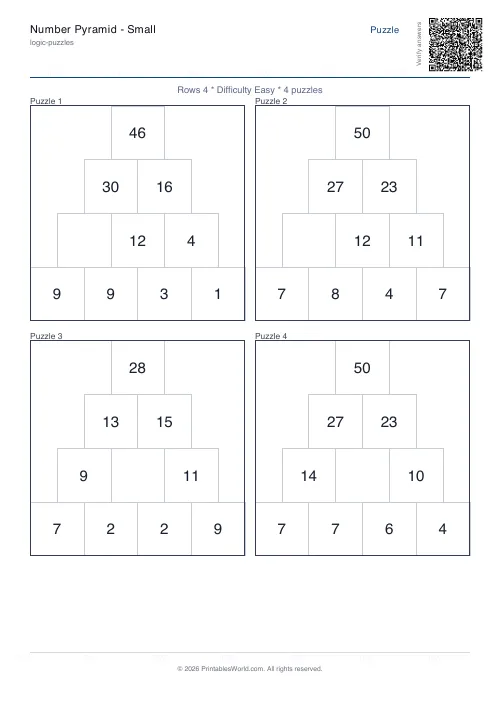
Number Pyramid Puzzle — Easy, with answer key
Completed answer key for the Easy number pyramid puzzle — print-ready PDF for fast marking.
↓ Download PDF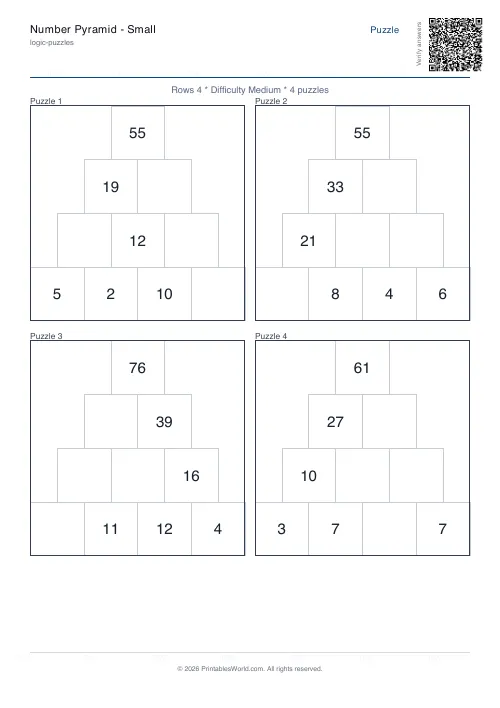
Number Pyramid Puzzle — Medium, with answer key
Completed answer key for the Medium number pyramid puzzle — print-ready PDF for fast marking.
↓ Download PDF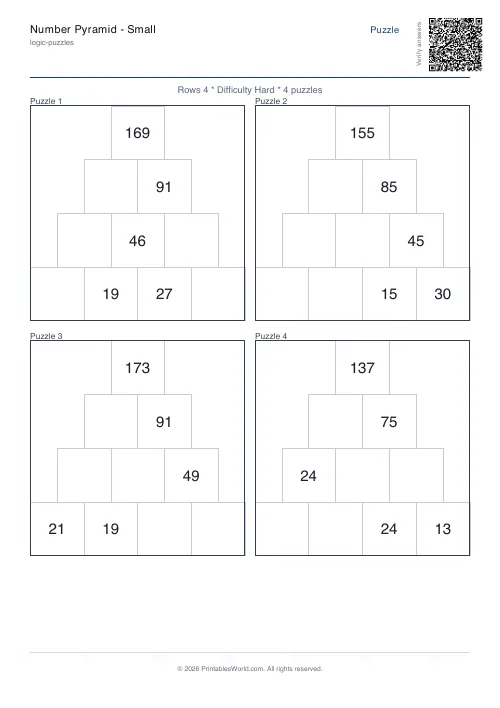
Number Pyramid Puzzle — Hard, with answer key
Completed answer key for the Hard number pyramid puzzle — print-ready PDF for fast marking.
↓ Download PDF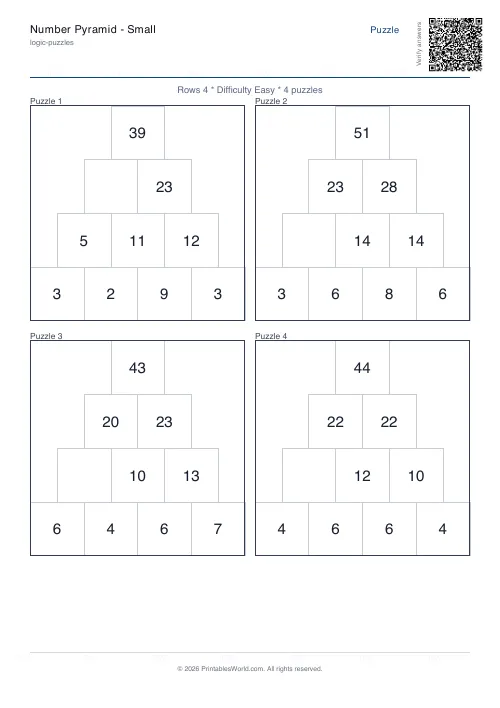
Number Pyramid Puzzle — 4 rows, with answer key
Completed answer key for the 4 rows number pyramid puzzle — print-ready PDF for fast marking.
↓ Download PDF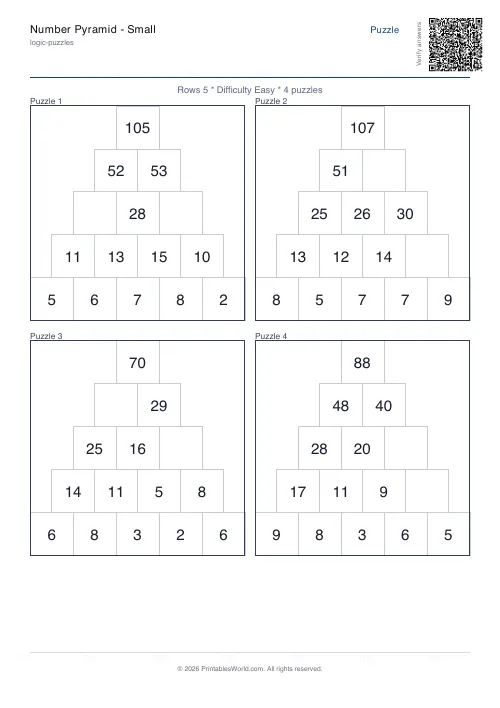
Number Pyramid Puzzle — 5 rows, with answer key
Completed answer key for the 5 rows number pyramid puzzle — print-ready PDF for fast marking.
↓ Download PDF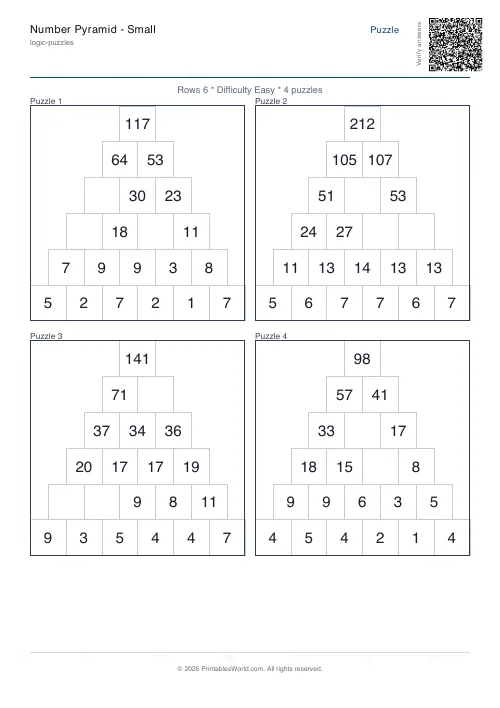
Number Pyramid Puzzle — 6 rows, with answer key
Completed answer key for the 6 rows number pyramid puzzle — print-ready PDF for fast marking.
↓ Download PDF
Settings
Customize your pyramid worksheet
6 medium pyramids per page (5 rows) on A4, plus a solutions page.
Rows
Difficulty
Paper size
Preview
Live PDF preview
The actual PDF, updated as you change settings.
People also used
Feedback
Spotted something off with this tool?
Create Printable Small Number Pyramids for Friendly Addition Practice
Generate free printable small number pyramids with four or five rows. Each block equals the sum of the two below it, so even young learners can start at the bottom and work upwards to complete the pyramid. Up to six large-cell puzzles per page with an optional solutions sheet, downloadable as a branded PDF in A4 or US Letter format.
Small pyramids are a confidence-building first taste of number-pyramid logic. They reinforce single-digit addition in a visual way and introduce the idea of missing-addend thinking gently. They also make a lovely quiet activity, classroom starter, or travel puzzle for short journeys.
This free printable small number pyramid generator helps parents, teachers, and tutors produce fresh addition practice for early Key Stage 2 learners in seconds.
Why use this small number pyramid generator?
A four-row pyramid contains ten cells, and a five-row pyramid fifteen. With easy ranges (values 1 to 9) the arithmetic stays in single digits, so learners focus on the logic of combining cells rather than on multi-digit addition. Use the generator for:
- Key Stage 1 and early Key Stage 2 addition practice
- classroom warm-ups and starter activities
- homework, revision, and early-finisher tasks
- home learning routines
- quiet activities after school
- short travel puzzles on car journeys and bus rides
- introducing deductive reasoning through addition
What you can customise
- Rows: four or five
- Difficulty: easy by default; affects value range and blanked cells
- Puzzles per PDF: up to six per page
- Include solutions: print a separate solutions page
- Large cells: toggle bigger cells for young writers (default on)
- Paper type: A4 or US Letter PDF
Four rows with large cells and six puzzles per page is the default so every child has plenty of room to write.
Notes and limitations
- All cell values are non-negative integers.
- Most puzzles leave the bottom row partially blank, so solvers must combine forwards addition with a little missing-addend reasoning.
- Print at 100 per cent scale so the large cells stay large.
Who these puzzles are for
Beginners
Four-row pyramids with easy ranges are the friendliest starting point. Learners quickly grasp that two cells add to the one above and enjoy the visual satisfaction of filling in the peak.
Puzzle enthusiasts
Use small pyramids as a warm-up before a harder puzzle session. Six pyramids take only a few minutes once the idea clicks.
Classroom teachers
Use small pyramids as a five-minute starter. They reinforce addition while introducing the language of logic puzzles, which pays off later in more advanced deductive reasoning.
Parents
Print a sheet before a car journey or a quiet afternoon. Small pyramids sit comfortably on a clipboard and keep children engaged without screens.
How to use the tool
- Choose four or five rows.
- Keep difficulty on easy for early learners.
- Set the number of puzzles per PDF.
- Toggle solutions and large cells as needed.
- Pick A4 or US Letter paper.
- Click Generate.
- Preview the layout.
- Download the PDF.
Worked example
Consider a four-row pyramid with a bottom row of 3, _, 2, 4 and the second row showing 7 above “3 and _”. The learner works out that the missing bottom cell is 7 − 3 = 4. From there, 4 + 2 = 6 fills the next second-row cell, 2 + 4 = 6 fills the last, and the third row becomes 7 + 6 = 13 and 6 + 6 = 12. The peak is 13 + 12 = 25.
Methodology
The engine samples a full bottom row from a small range, computes every cell above it by adding adjacent pairs, then blanks a handful of cells to leave an age-appropriate challenge. Solutions, if enabled, reproduce the completed pyramid on a separate page for parents or teachers to mark.
Helpful preset ideas
- Rows 4, difficulty easy, large cells on, for Key Stage 1
- Rows 5, difficulty easy, for early Key Stage 2
- Rows 5, difficulty medium, as a stepping stone to the large variant
- Solutions on for quick parent marking
Gentle strategies for young solvers
- Start at the bottom. If both lower cells are filled, add them to get the cell above.
- If a cell is known but only one child is, subtract to find the other child.
- Encourage learners to write faintly so they can erase if they change their mind.
- Celebrate the peak. Reaching the top cell feels like a small victory and keeps motivation high.
Designed for A4 and US Letter Printing
The worksheet supports both A4 and US Letter paper sizes so British, European, and North American users can print without tweaks. Cell sizes scale automatically, so the large-cell default still fits six pyramids per page on either paper.
Related logic puzzle printables
FAQs
Quick answers
Who is this worksheet for?
Children who are confident with single-digit addition and ready to apply it in a small puzzle format. Most rows use values from 1 to 9.
How many pyramids will I get?
Up to four large pyramids per page so younger learners have plenty of room to write.
Are answers included?
Yes — toggle the solutions option to add a separate page of completed pyramids.
Can I make them harder?
Yes. Try the large variant for 6-8 rows and bigger numbers.
Related tools
More like this
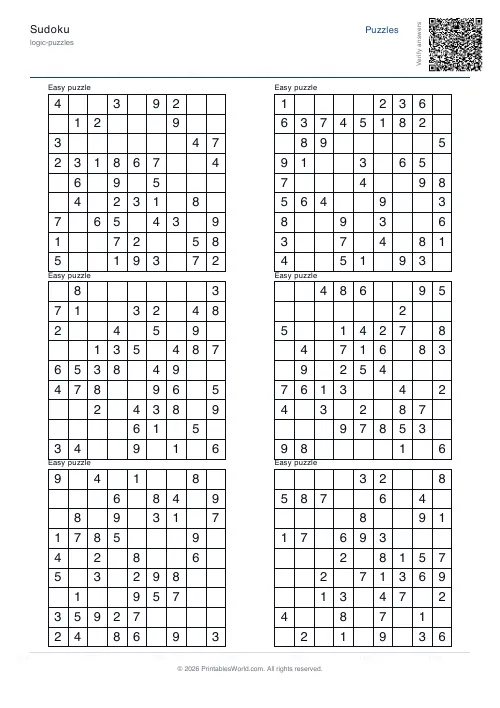 Sudoku Generator
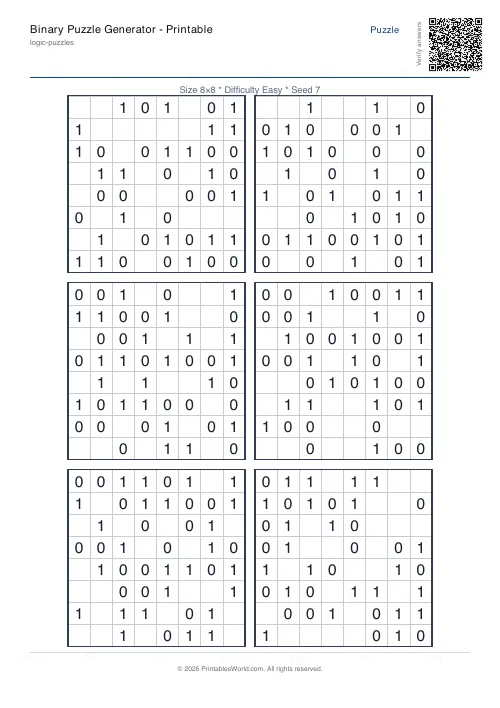 Binary Puzzle Generator — Printable
 Number Pyramid Generator
 Number Chain Generator — Mental Maths
 Logic Grid Puzzle Generator — Printable
 Sudoku — 9x9 Easy
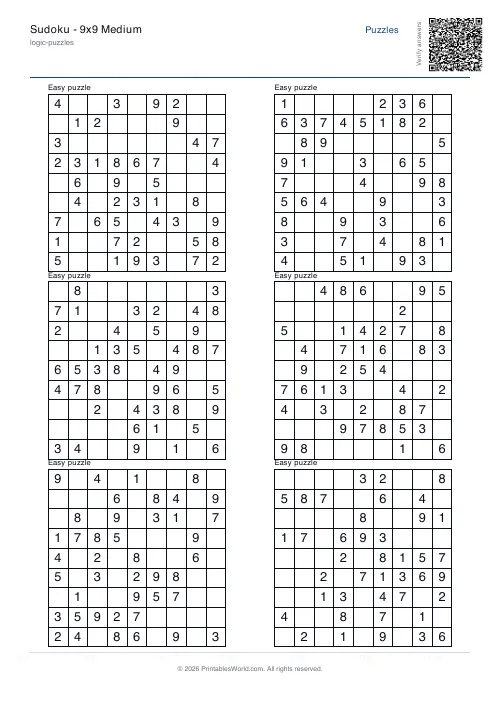 Sudoku — 9x9 Medium
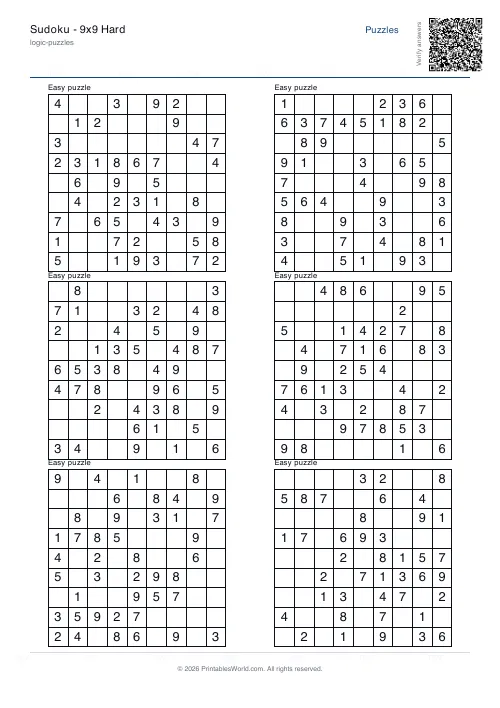 Sudoku — 9x9 Hard
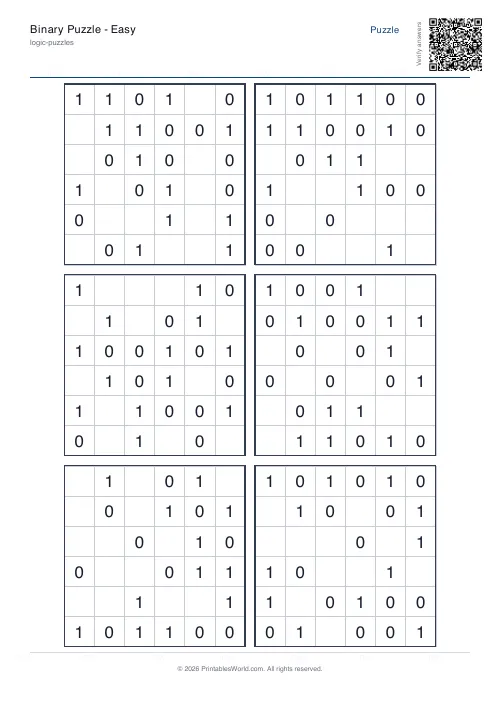 Binary Puzzle — Easy
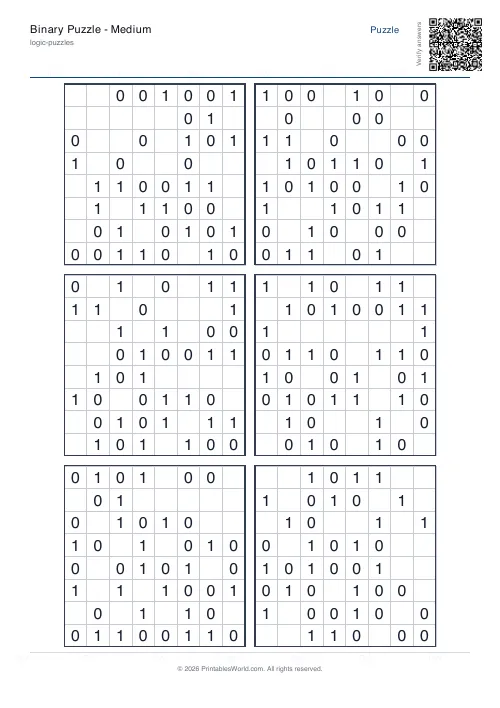 Binary Puzzle — Medium
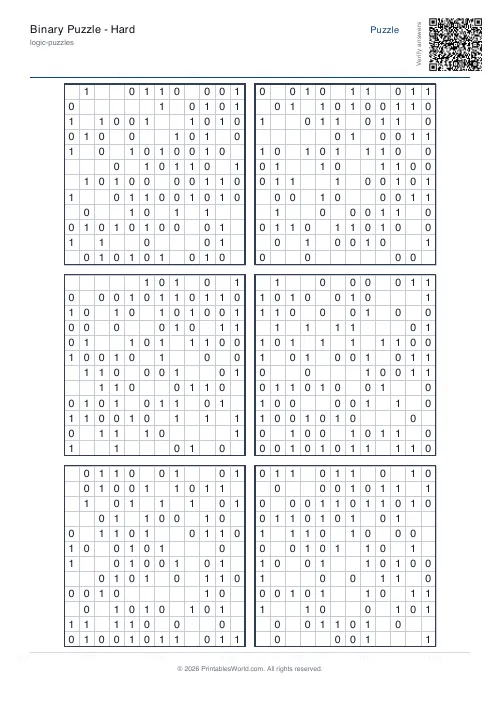 Binary Puzzle — Hard
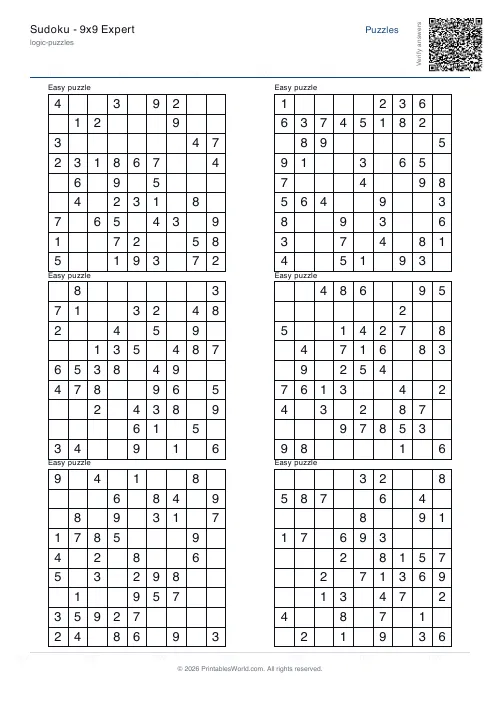 Sudoku — 9x9 Expert
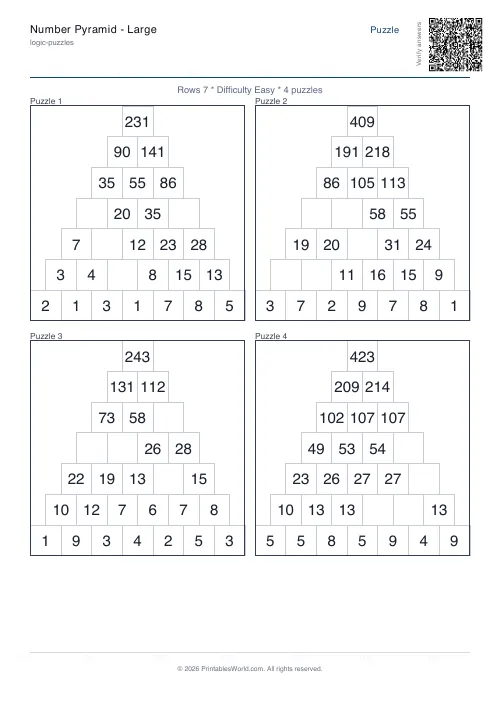 Number Pyramid — Large
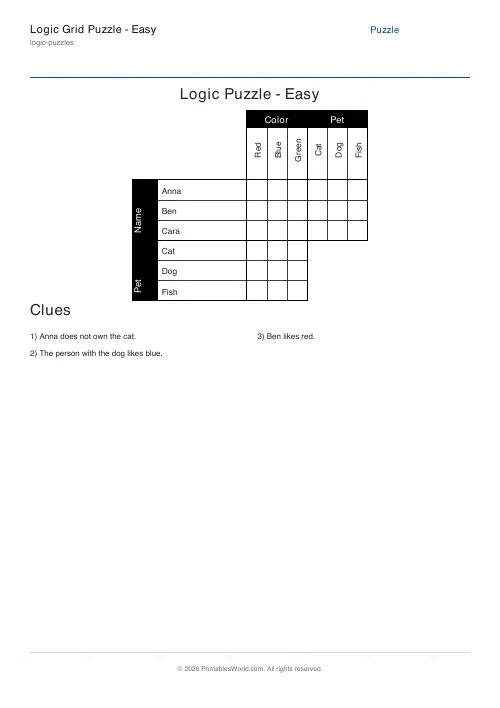 Logic Grid Puzzle — Easy