What this tool does
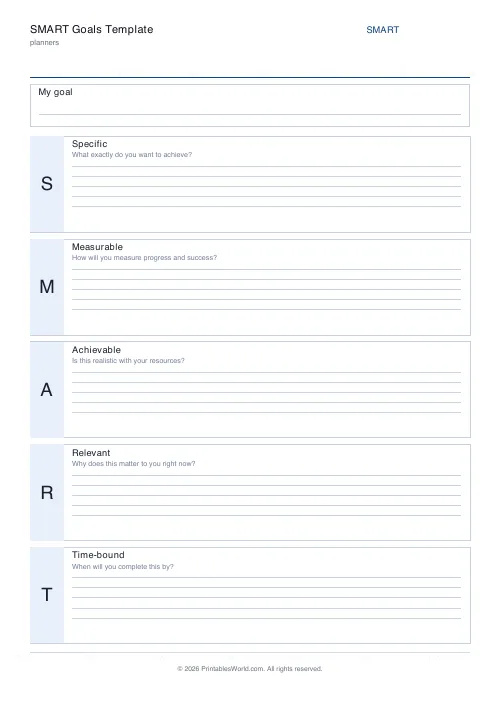
A one-page SMART goal template. Five labelled boxes — Specific, Measurable, Achievable, Relevant, Time-bound — each with its prompt question and writing lines.
People also used
Feedback
Spotted something off with this tool?
Five boxes, five questions
One page, five labelled sections. Each carries the question you are supposed to be answering, not only the letter it stands for.
S — what exactly do you want to achieve? M — how will you measure progress and success? A — is this realistic with the resources you have? R — why does this matter to you right now? T — when will you complete it by?
Why the questions are printed
Because everyone can recite the acronym and most people cannot use it.
A box labelled only "Measurable" gets a vague answer. A box that asks how you will measure progress and success gets a number back, and the number is the entire point of the letter. Printing the prompt turns a mnemonic into a form. Forms get filled in.
The two letters that do the work
Measurable is the one that converts a wish into a goal. "Get fitter" cannot be measured and therefore cannot be started; "run 5k without stopping" can be tested on any given Saturday. If you cannot say what evidence would prove it done, keep rewriting until you can.
Time-bound is the one that gets skipped and the one that supplies urgency. A goal with no deadline is a preference, and preferences do not survive a busy month.
Relevant is not a formality
The R box asks why this matters to you now, and answering it honestly kills a certain number of goals on the page. That is a useful outcome.
Goals adopted because they sounded like the right thing to want — somebody else's ambition, an idea of who you ought to be — do not survive the first difficult week. Better to find that out on a sheet of paper in ten minutes than in March.
Working through it
One goal per sheet. Splitting the page between two goals defeats the specificity the whole framework is for.
Write in pencil. The S box nearly always needs rewriting once the M box has demonstrated how vague it was. Then put the sheet somewhere you will see it, and review it against the T date instead of continuously.
Where it fits
Appraisals and personal development plans. Study targets and revision planning. Fitness. Savings, habits. It is used in schools for pupil target-setting, and it works well from about age ten — younger children usually need the goal broken into steps, which is what the step chart is for.
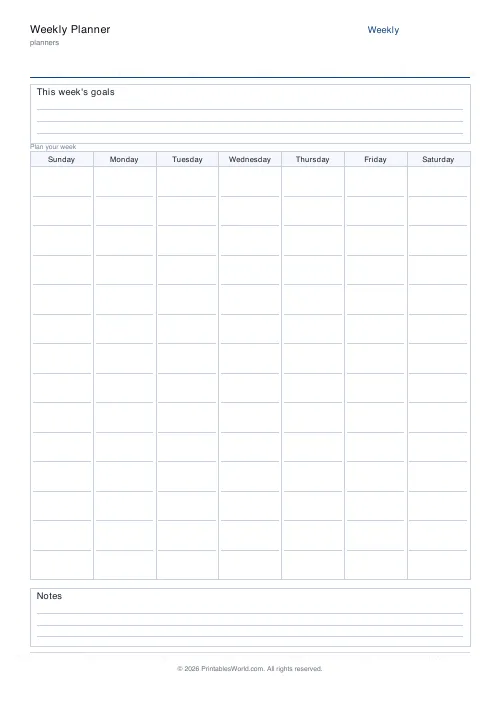
Once the goal is written, the work is scheduling it. That belongs on the weekly planner.
FAQs
Quick answers
What does SMART stand for?
Specific (clear outcome), Measurable (you can tell when you are done), Achievable (realistic with your resources), Relevant (worth doing), Time-bound (has a deadline).
Is one SMART goal enough for the year?
Usually yes. Aim for one or two per quarter. Any more and you dilute your focus.
Can I use it at work?
Yes. It works equally well for personal goals, student projects, and professional development plans.
What if my goal is not time-bound?
Add a soft review date instead (e.g. "review in 30 days"). A habit goal without any end date is still easier to track with a monthly checkpoint.
Related tools
Further reading
Planners
Time blocking for beginners: a complete guide
Time blocking is deciding when each task happens, not just what. Here is how to size blocks realistically, what to do when the day breaks, and why most beginners over-schedule.
5 min read
Planners
Meal planning 101: save time and money every week
A weekly meal plan saves money mainly by changing how you shop. Here is a thirty-minute method, the shortcuts that keep it going, and the mistake that ends most plans in week three.
5 min read