What this tool does
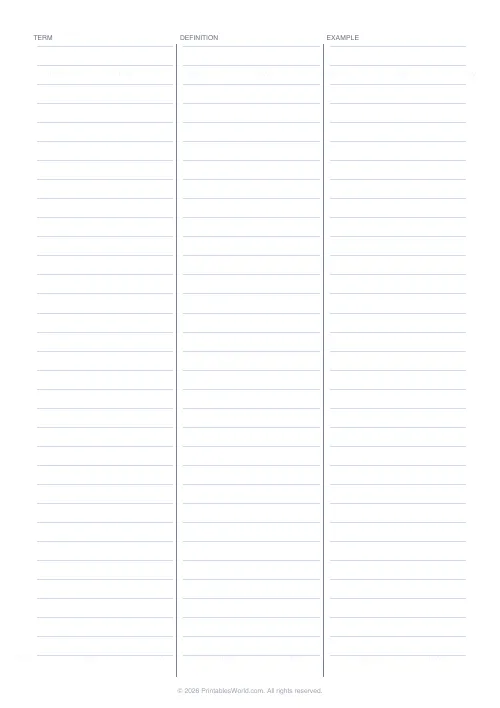
Three equal ruled columns headed TERM, DEFINITION, EXAMPLE — for vocabulary and concept notes.
People also used
Two-Column Notes Template
Split-page note layout. Left for key points, right for detail.
Cornell Notes Template
Classic Cornell note-taking layout with cue column and summary.
Lined Paper Generator
Generate custom ruled paper PDFs with adjustable line spacing, colours, margins, and primary ruling styles.
Feedback
Spotted something off with this tool?
Three columns, three headings
The page splits into equal thirds with a heavy divider between them, and each column is headed and ruled. TERM on the left, DEFINITION in the middle, EXAMPLE on the right.
Nothing else. It is a fixed format, and the constraint is the design.
The example column is the whole point
A term and a definition is a flashcard, and flashcards produce recognition rather than understanding.
The example column is where you find out whether the definition landed. A student who can write "photosynthesis" and copy a definition may have understood nothing; a student who can produce their own example has understood something, and the failure to produce one is a useful, visible signal rather than a hidden gap.
Insist the example is theirs and not the textbook's. Copying the worked example from the page defeats the exercise entirely.
Where it fits
Vocabulary in any language subject, where the third column is the word used in a sentence. Scientific and technical terms. Legal and medical definitions. Mathematical terms, where the example is a worked instance.
It also works for grammar — rule, explanation, sentence — and for literary devices, where the third column is a quotation.
Filling it in during a lesson
Term and definition as you go. Leave the examples blank.
Then fill the third column afterwards, from memory, without looking at anything. That two-stage approach turns note-taking into retrieval practice, which is a considerably more effective use of the same twenty minutes than copying three columns at once.
Revising from it
Fold the sheet along a divider — the columns are equal thirds precisely so it folds cleanly.
Cover the definition and work from the term. Then cover the term and work from the definition, which is the harder direction and the one that actually tests knowledge. Cover both and see whether the example alone brings the term back.
Related layouts
For lecture notes rather than vocabulary, Cornell notes gives you a cue column and a summary strip. For comparisons, two-column notes is the simpler version.
FAQs
Quick answers
What goes in each column?
Term, definition, and example. But you can adapt the labels to suit any three-part recall pattern.
Is this good for language learning?
Yes. Use it for word, translation, and a sample sentence.
Are the columns ruled?
Yes. Faint horizontal rules at 8 mm spacing throughout.
Will it print on A4?
Yes. A4, US Letter, and US Legal are supported.
Related tools
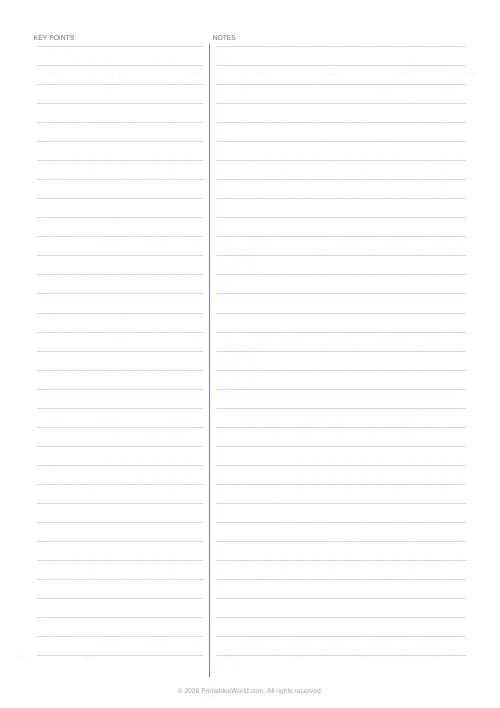
Two-Column Notes Template
Split-page note layout. Left for key points, right for detail.
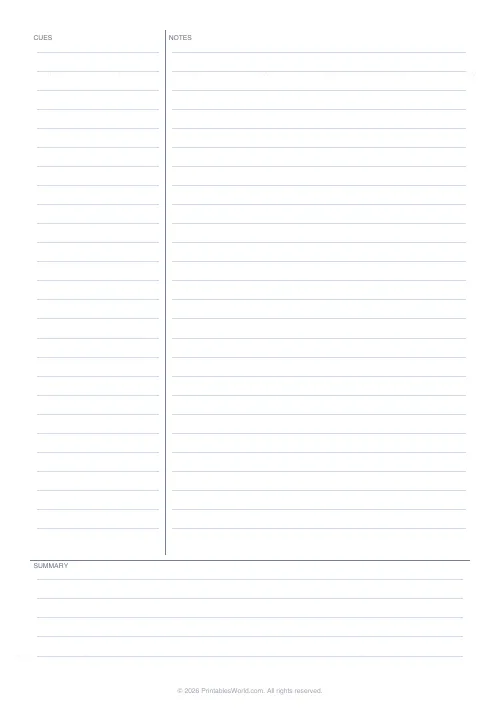
Cornell Notes Template
Classic Cornell note-taking layout with cue column and summary.

Lined Paper Generator
Generate custom ruled paper PDFs with adjustable line spacing, colours, margins, and primary ruling styles.
Further reading