

What this tool does
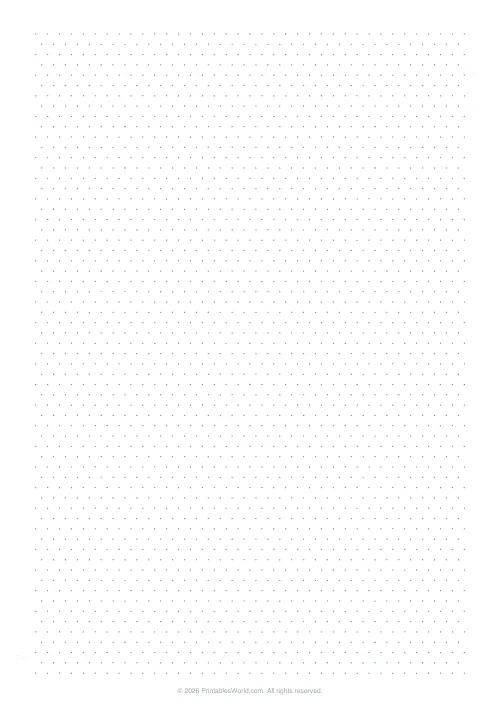
A triangular dot lattice at 60 degrees, for isometric and 3D sketching. Dot spacing of 5, 7 or 10 mm.
People also used
Feedback
Spotted something off with this tool?
Dots on a 60-degree lattice
Rows of dots offset so that any three neighbours form an equilateral triangle. Nothing is printed between them, which is the point.
Spacing at 5, 7 or 10 millimetres.
Why dots rather than lines for isometric work
Because you are drawing an object and the grid is scaffolding.
On line paper every triangle edge is printed, so a finished drawing sits inside a mesh and the object competes with the grid. With dots, you draw only the edges the object actually has, and everything else recedes.
The rule of thumb: dots for drawing, lines for pattern work where the triangle itself is the unit.
What isometric actually means
Three axes at 120 degrees to each other, with no perspective and no vanishing point. A cube drawn this way has three visible faces, all the same size, and its parallel edges stay parallel.
That is not how the eye sees. Real perspective converges, and this deliberately does not, because an isometric drawing preserves measurement instead: a 30mm edge stays 30mm wherever it sits on the page, so you can scale distances straight off the drawing. Engineering uses it for that reason. So do Lego instructions.
Drawing a cube on it
Worth doing once before anything else, because everything follows from it.
Start at a dot. Go three dots up-and-right, three up-and-left, and three straight down; that is one rhombus. Add two more rhombi sharing the edges and the cube appears, with three faces meeting at the top vertex.
Everything harder is that same shape repeated, or stretched, or stacked on top of itself. Children reach a convincing 3D drawing inside five minutes, which is unusual for anything involving perspective at all.
Spacing
Five millimetres is fine work and a busy page. Ten gives large, clear units and suits a first attempt or a diagram to be photographed.
Seven is the compromise nobody asks for and a surprising number of people end up preferring.
Where it gets used
Technical drawing and DT lessons. Product sketching. Furniture and room layouts in 3D rather than plan. Voxel and pixel art. Board-game terrain. Maths lessons on volume, where drawing a stack of cubes and counting them is easier on this paper than on plain.
Print at 100% on A4, US Letter or US Legal — at any other scale the spacing is no longer the millimetres you asked for, which matters as soon as anything is being measured off the drawing.
FAQs
Quick answers
What is isometric dot paper?
A grid of dots on a triangular lattice. Three lines of dots cross at every point, making it ideal for drawing isometric (3D) shapes.
How is the spacing measured?
The number you pick is the horizontal distance between adjacent dots in the same row.
Will it print on A4?
Yes. A4, US Letter, and US Legal are supported.
Can I get isometric line paper instead?
Yes. Try Isometric Grid Paper for the line version.
Related tools
Isometric Grid Paper
Triangular line grid at 30°/60° for isometric drawing.
Hex Grid Paper
Hexagonal grid for board game design, mapping, and strategy games.
Dot Grid Paper
Subtle 5 mm dot grid. Perfect for bullet journalling and notes.
Pixel Art Grid: Large (32×32)
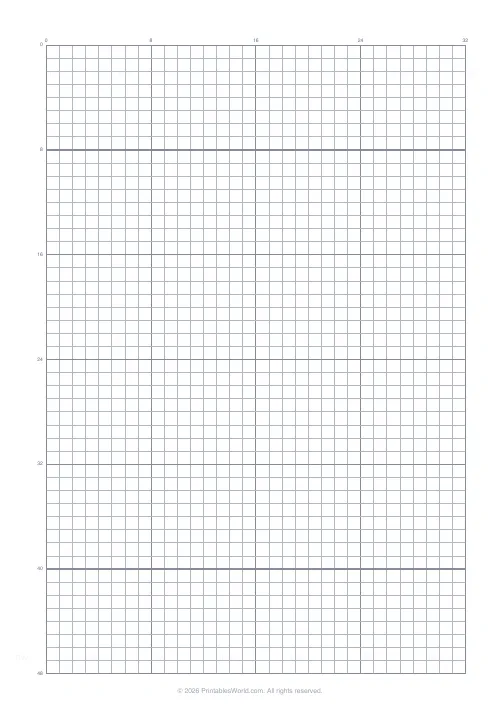
Larger 32×32 pixel grid with numbered axes for detailed sprite work.

Triangular Grid Paper
Full equilateral-triangle mesh with three line families at 0°, 60° and 120°.
Further reading
Printable Paper
Bullet journalling with dot grid paper: a starter guide
The bullet journal was designed to be fast, not beautiful. Here is the original system, why dot grid suits it better than lines or blank, and the four pages you actually need.
5 min read
Printable Paper
Graph paper sizes: which grid for which task
What graph paper sizes and grid spacings mean, how to match a grid to maths, art or design, and how to set it all in the free graph paper generator.
7 min read
Printable Paper
The best note-taking paper for students (Cornell, grid, lined)
The paper you take notes on quietly decides how you review them. Here is what each format is actually for, and which subjects each suits.
4 min read