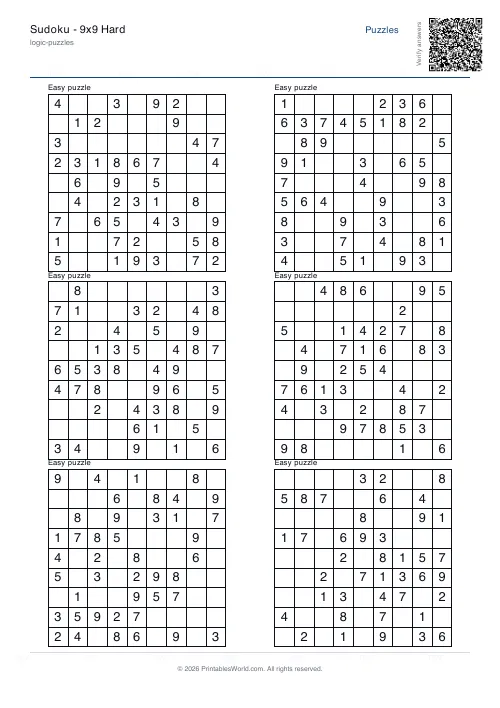
What this tool does
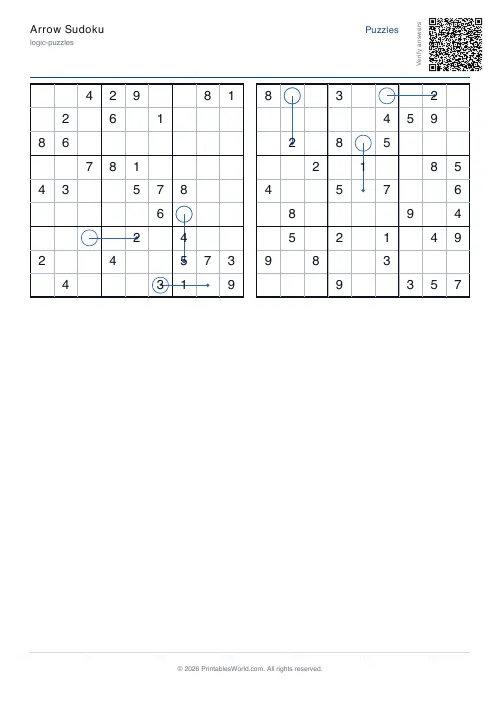
Sudoku with arrows drawn over it: the digits along each arrow add up to the number in its circled cell, on top of the usual row, column and box rules.
People also used
Feedback
Spotted something off with this tool?
Arrows that add up
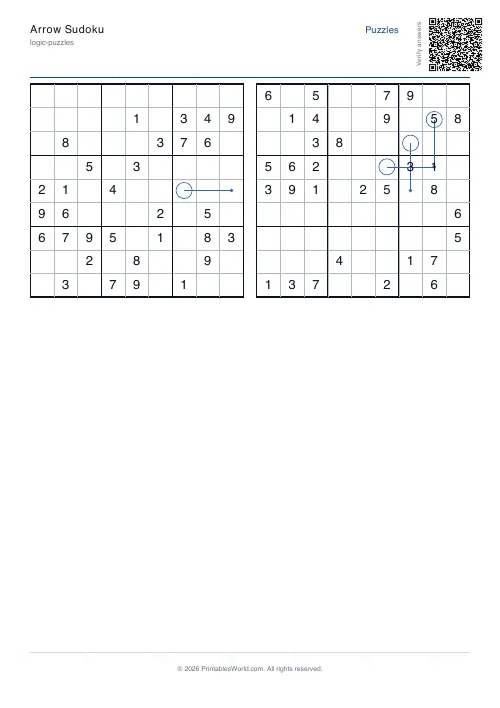
An ordinary 9×9 sudoku with a handful of arrows drawn over it. Each arrow begins in a circled cell, and the digits along its line have to add up to the number sitting in that circle.
Everything else is unchanged: 1 to 9 once per row, once per column, once per box.
An honest note on how these are built
The grid is generated as a standard sudoku first, with between 28 and 34 givens, and the clues are carved so it has exactly one solution under the ordinary rules alone. The arrows are then drawn onto lines that already satisfy the sum in that solution.
So the arrows are always true, and they will often save you time — but you never need them. You cannot reach a position where only arrow logic can rescue you, because the grid was solvable without it.
That is a deliberately conservative construction. An arrow puzzle carved to depend on its arrows is a harder and better puzzle, and it is also one where a single misread overlay makes the grid unsolvable. These sheets are safe to hand to a room.
What an arrow tells you
More than it looks, because the circle can only hold a digit from 1 to 9.
A two-cell arrow summing into a circle cannot have a circle below 3, since the smallest two distinct digits are 1 and 2. A three-cell arrow needs a circle of at least 6. Conversely a circle of 3 on a two-cell arrow is fully determined — it is 1 and 2, in one order or the other, and the row and column rules pick which.
Those bounds are where an arrow earns its place. Beginners use arrows to confirm what they already worked out. Solving through them is faster.
Digits on an arrow may repeat
The rule that catches people arriving from killer sudoku, where a cage may not repeat a digit.
An arrow has no such rule. Only the sum matters, so an arrow crossing two different boxes can perfectly well carry the same digit twice, provided the row, column and box rules allow it.
Sizing it
Puzzles per page from 1 to 4, the solutions page, and a seed. A4 or US Letter.
Two to a page keeps the overlays crisp, which matters more here than on a plain grid — a circle that does not read clearly as a circle is a puzzle you cannot start.
For cages and sums instead of arrows, the killer sudoku is carved so that its clues actually do the work: the cage layout has to pin the grid before the puzzle ships. Print at 100%.
FAQs
Quick answers
How does the arrow rule work?
Cells along an arrow add up to the digit in the arrow’s tail (circled) cell.
Are puzzles guaranteed unique?
In v1 the arrow constraints are added on top of the standard sudoku givens but uniqueness is not strictly verified.
How many per page?
Two grids per page so the arrows stay clearly visible.
Want other variants?
Try Thermo Sudoku, Diagonal Sudoku, or Irregular Sudoku.
Related tools
Thermo Sudoku
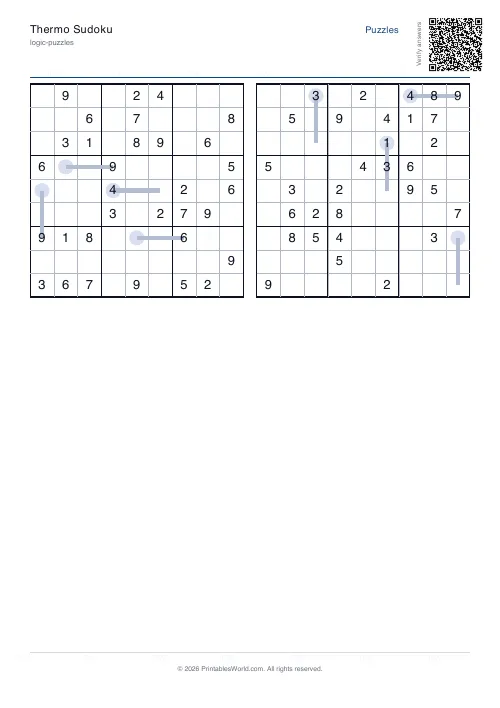
Digits along thermometer shapes must increase from bulb to tip.
Diagonal Sudoku
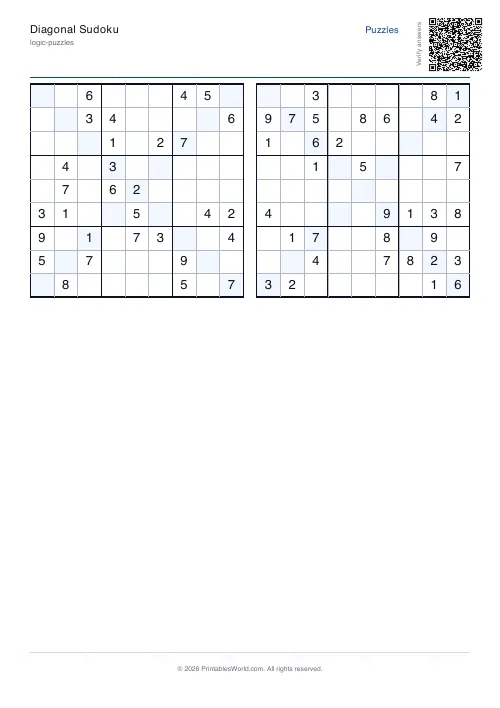
Standard Sudoku with the added constraint that diagonals must contain 1-9.
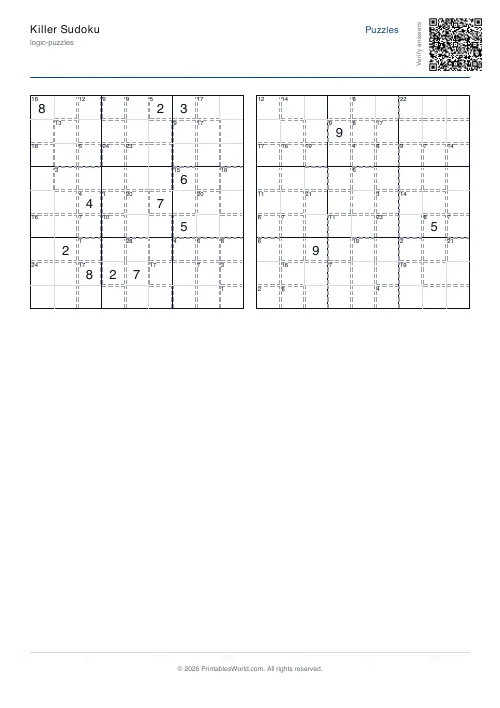
Killer Sudoku
Sudoku variant where cages must sum to given totals. Generates unique puzzles.
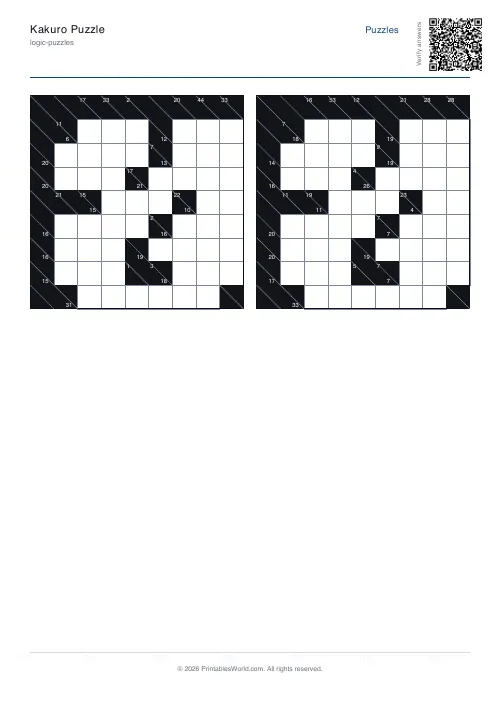
Kakuro Puzzle
Cross-sum number puzzle where digits in groups must add to clues.
Further reading
Logic Puzzles
How to solve Sudoku: a beginner's step-by-step guide
Four techniques, learned in order, solve almost every easy and medium Sudoku: scanning, the last free cell, pencil marks and naked pairs. Here is each one with a worked example.
6 min read
Logic Puzzles
Kakuro, killer sudoku and other number puzzles explained
If sudoku has stopped being a challenge, these are the natural next steps. And unlike sudoku, most of them genuinely involve arithmetic.
5 min read
Puzzles & Brain Games
Sudoku for kids: which difficulty to start at, by age
A practical guide to picking the right sudoku difficulty for a child by age, with a copyable first session and free printable grids in seconds.
7 min read